
House Subsidence Engineers: Chartered Structural Engineering, Dublin
A diagonal crack appearing above a door frame. A floor that slopes slightly where it never did before. A window that jams in its frame on a warm day. These are the signs that worry homeowners and rightly so. Subsidence is one of the most serious structural problems a property can experience, and it requires a Chartered Structural Engineer, not a builder, to investigate it correctly and confirm what is happening.
Banrach Consulting Engineers are Chartered Structural Engineers in Ireland with extensive experience in subsidence investigation, monitoring, and permanent remediation. We work with private homeowners, commercial property owners, and insurance companies across Dublin and Ireland. Our process to investigate, monitor, and remediate is designed to give you certainty: what is causing the movement, whether it is ongoing, and what the permanent fix is.
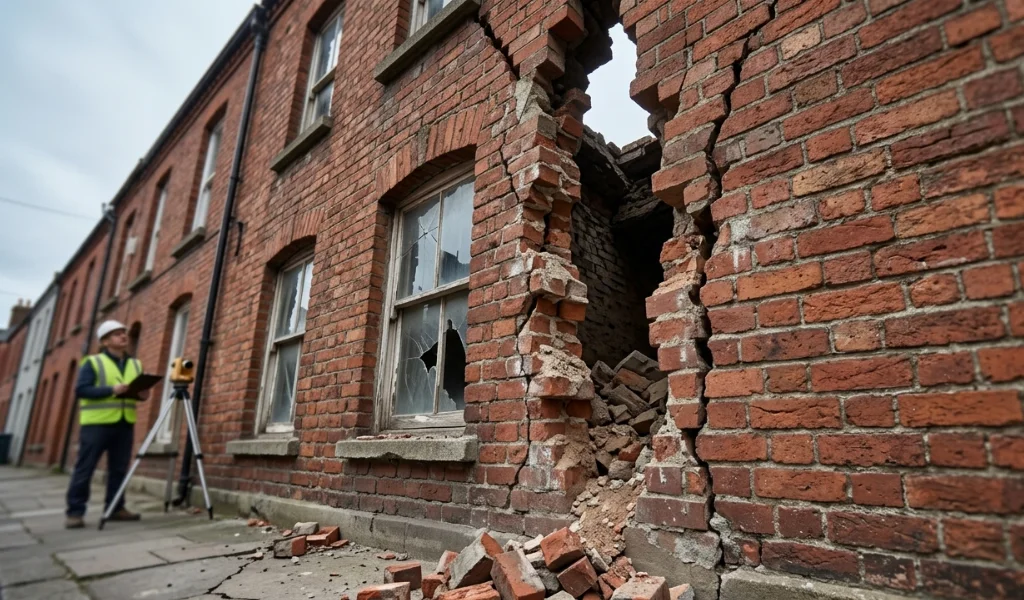
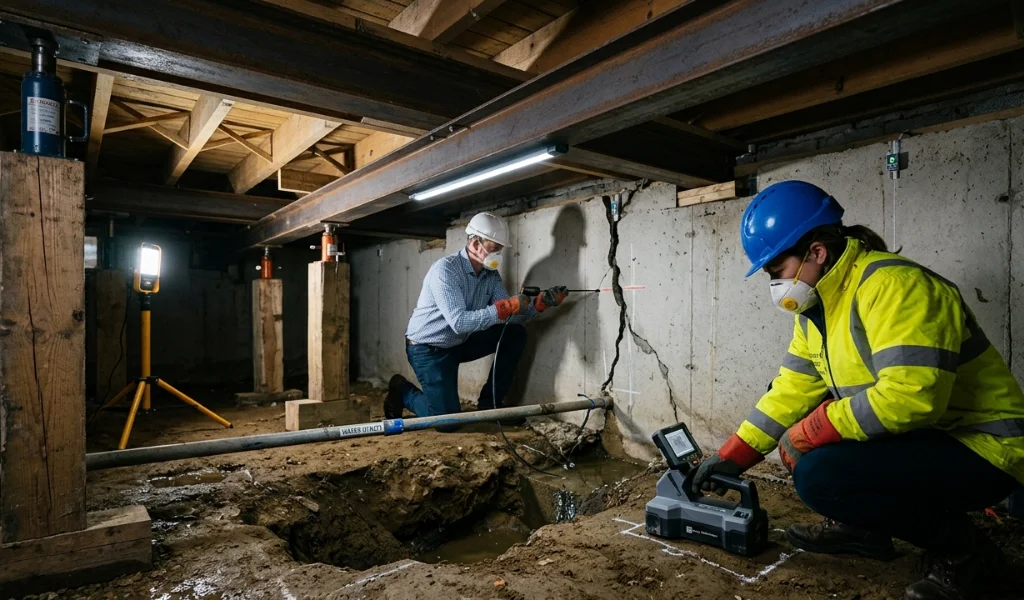
What a Subsidence Engineer Does
The term 'subsidence engineer' refers to a Chartered Structural Engineer with specific experience in ground movement and its effect on buildings. Not all structural engineers have this specialism. Subsidence investigation requires understanding of soil mechanics, foundation behaviour, crack patterns, and the interaction between trees, drains, and clay soils.
A subsidence engineer's role covers three distinct phases:
| Phase | What It Involves |
|---|---|
| 1. Investigation | Establishing what is causing the movement and where it is occurring, through a site visit, crack mapping, and a review of the property's drainage and surroundings |
| 2. Monitoring | Placing tell-tales and monitoring stations on cracks to quantify movement over a defined period, so we can determine whether movement is active or historic |
| 3. Remediation | Specifying and supervising the permanent repair: underpinning, resin injection, drainage repair, or tree removal, depending on cause and severity |
Signs That You Need a Subsidence Engineer
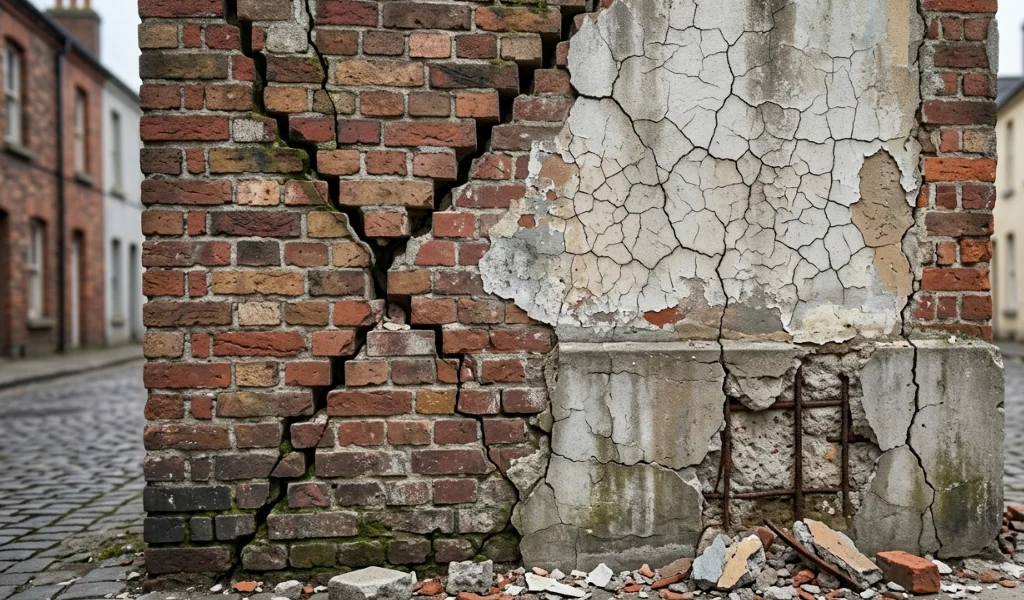
Not every crack in a wall indicates subsidence. Most cracking in Irish homes is cosmetic hairline plaster shrinkage, thermal movement, or normal settlement in a new build (Signs of Subsidence). The signs that indicate genuine subsidence and warrant a Chartered Structural Engineer include:
- Diagonal cracks running at approximately 45 degrees, particularly near door or window openings, wider at the top than the bottom: the classic pattern of differential foundation settlement
- Cracks that are more than 3mm wide, or that you can insert a 10 cent coin into: these are structural rather than cosmetic
- Cracks that reappear after being filled, indicating ongoing movement rather than historic cracking
- Doors or windows that are sticking or jamming, particularly if this is a new development rather than a long-standing building characteristic
- Sloping floors, particularly relevant in older Dublin properties on clay soils
- Cracks that are visible both internally and externally on the same wall, indicating through-wall movement
- Gaps appearing between the wall and skirting board, or between window and door frames and the surrounding structure
The Banrach Subsidence Investigation Process
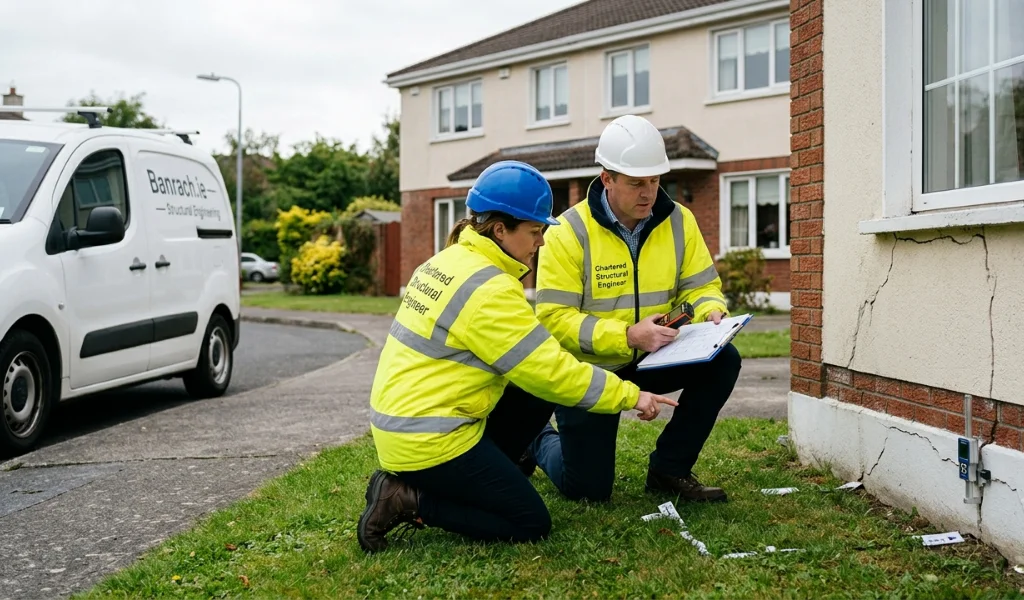
- Stage 1: Initial Site Assessment Our Chartered Structural Engineer visits the property to carry out a thorough inspection. This involves:
1.A full inspection of all cracks location, orientation, width, and taper (which end is wider)
2. A check of all drainage on and adjacent to the property, as blocked or leaking drains beneath a building are among the most common causes of subsidence in Dublin
3.Assessment of trees and large shrubs in proximity to the building clay-soil shrinkage caused by tree root moisture extraction is the most common subsidence cause in Dublin's southside clay soils
4. A review of the property's foundations (where accessible or from records) and original construction
5. A desktop review of soil type, local drainage, and historical OS maps where relevant - Stage 2: Monitoring Where movement is active or its extent is unclear, we install a monitoring programme. Tell-tales (glass or plastic crack monitors) are placed on all significant cracks and read at agreed intervals typically monthly for the first three to six months. This data determines:
1. Whether movement is ongoing or historic
2. The rate and direction of movement
3. Whether the movement is seasonal (indicating tree root influence on clay soils) or continuous (indicating drainage or loading problems)
Monitoring data is the foundation of the engineer's report and the primary basis on which insurance companies accept or decline subsidence claims. A report without monitoring data is rarely sufficient for an insurer. - Stage 3: Chartered Engineer's Report On completion of investigation and monitoring, Banrach issues a Chartered Structural Engineer's Report covering the cause of movement, the extent and nature of any structural damage, the likely prognosis (will movement continue or has it ceased?), and a specification for remediation. This report is the definitive professional document required by insurers, solicitors, and mortgage lenders.
- Stage 4: Remediation Design and Supervision We design and specify the permanent repair which may involve underpinning, resin injection, drainage repair, or a combination and supervise its execution by a specialist contractor. Our sign-off on completion of remediation is the document that closes the insurance claim and removes the 'subsidence history' notation from the property's records where the repair is certified as permanent.
Permanent Repair: Underpinning and Resin Injection
Traditional underpinning extends the existing foundation to a deeper, more stable bearing stratum. It involves excavating in short bays beneath the existing foundation, pouring mass concrete, and repeating across the affected area. Mass concrete underpinning is highly reliable and has decades of track record. It is typically the remedy specified for severe or widespread subsidence.
Resin injectionResin injection (also known as helical pile injection or polyurethane resin injection, depending on system) is a less disruptive remediation method. Resin is injected through small-diameter tubes drilled through the floor slab into the sub-base. The resin expands to fill voids, consolidate loose material, and in some systems, to lift and re-level the structure. Resin injection is faster, less disruptive, and may be more cost-effective for certain types of subsidence particularly where excavation is difficult or the movement is localised.
The choice between traditional underpinning and resin injection depends on the cause, extent, and soil conditions not on cost alone. Banrach specifies the appropriate method for the specific circumstances, not the cheapest available option.
Subsidence Engineering for Insurance Claims
Banrach Consulting Engineers work with homeowners and commercial clients whose subsidence claims are being processed by their insurers. We also work directly for loss adjusters and insurance companies requiring an independent Chartered Structural Engineer's assessment. Our engineers understand the documentation requirements for insurance claims: the monitoring period, the cause investigation, the report format, and the certification of completed remedial works. A Chartered Structural Engineer's report from Banrach is accepted by all major Irish insurers.Our insurance work covers:
- Independent investigation and report for homeowners whose claim has been queried or declined
- Monitoring and cause reports for loss adjusters
- Remediation specification and supervision for insurance-funded repairs
- Certification of completed remedial works for mortgage lender and conveyancing purposes
Subsidence Causes in Dublin and Ireland
Understanding the cause of movement determines the appropriate remedy. The table below sets out the most common causes we see across Dublin and Ireland.
| Cause | How Common in Dublin | Typical Remedy |
|---|---|---|
| Clay shrinkage, tree root moisture extraction | Very common, Dublin southside clay soils particularly susceptible | Tree removal or root barrier, plus underpinning or resin injection |
| Leaking drains, washing out sub-base material | Common across all areas, typically older clay drainage | Drain repair (CCTV survey first), void filling, foundation repair |
| Poor fill or made ground | Applies to properties built on disturbed or filled sites | Underpinning to reach solid bearing strata |
| Mining or cavity collapse | Less common, some older limestone areas | Grouting or specialist underpinning |
| Overloading | Commercial extensions or conversions | Load reduction or foundation strengthening |
Every case is different. Our Chartered Structural Engineer confirms the cause through investigation and monitoring before any remedy is specified.
Who We Work With
- Private Homeowners If you have noticed signs of possible subsidence in your home, the first step is a professional assessment. We provide initial inspections, monitoring programmes, and remediation advice across Dublin and Ireland. Contact us before carrying out any repairs.
- Commercial Property Owners Offices, retail units, industrial buildings, and apartment blocks are subject to the same subsidence risks as residential property, often with greater structural complexity. Banrach has experience with multi-storey and mixed-use buildings.
- Solicitors & Conveyancers Property transactions involving a subsidence history require a Chartered Structural Engineer's assessment and, where remediation has been carried out, a certificate of completion. We provide pre-purchase and retrospective assessments.
- Loss Adjusters & Insurers We work with loss adjusters and insurers as an independent Chartered Structural Engineering practice, providing impartial investigation reports, monitoring data, and remediation supervision to claims management standards.
Frequently Asked Questions
-
What is the difference between subsidence and settlement?
Settlement is the gradual, expected downward movement of a building as it compresses the soil beneath its foundations, and is generally symmetrical. Subsidence is differential downward movement: one part of the foundation moves more than another, causing structural distortion such as cracking, sloping, and sticking doors. -
Can I sell my house if it has subsidence?
Yes, but a property with a subsidence history must be disclosed to the buyer. If the subsidence has been professionally investigated, monitored, and remediated with a Chartered Structural Engineer's certificate of completion, the property can typically be sold and mortgaged normally. Properties with active subsidence or unresolved claims are more difficult to sell or mortgage. -
How long does a subsidence investigation take?
The initial site assessment typically takes one to two weeks from engagement to completion. Where a monitoring period is required, which is common in insurance cases, monitoring runs for three to twelve months depending on the nature of movement. The full process, from initial inspection to remediation completion, typically takes six to eighteen months for a standard domestic claim. -
Is underpinning always required for subsidence?
Not always. If the cause of subsidence has been removed, for example a tree removed or a drain repaired, and monitoring shows that movement has ceased, underpinning may not be required. The engineer's report determines the appropriate course of action based on the cause, extent of movement, and monitoring results.
Concerned About Subsidence? Contact Banrach
If you have noticed signs of possible subsidence in your home or commercial property, contact us for a professional assessment from a Chartered Structural Engineer.